


Becoming a full-time trader takes 1 to 3 years of experience and requires using tips such as a strict 1% risk-per-trade limit, at least 100 paper trades before going live, and analyzing results to identify where you can improve. Learn what it actually requires to transition from a steady job to generating consistent income through day trading.
At WR Trading, we are professional traders who have gone through this exact transition ourselves and have spent years observing what separates those who succeed from those who do not.
This guide provides ten tips we have identified as necessary for anyone who wants to become a professional full-time day trader and earn a living from trading the markets:
- Start Small
- Practice
- Start Next To Your Job
- Learn The Basics
- Watch Real Examples
- Open A Brokerage Account
- Put In Months and Years Of Hard Work
- Test Out Different Strategies
- Create A Trading Plan
- Analyze Results
1. Start Small
We recommend that every trader begin with the smallest possible position size relative to their total account balance. The switch from simulated trading to real money introduces psychological variables that cannot be fully controlled, and a strict risk cap is the only reliable defense in our experience.
Our specific guidance is to limit the maximum loss on any single trade to 1% of total account equity. For an account valued at $10,000, this translates to a maximum dollar loss of $100 per trade, which then dictates the share or contract size based on the distance to the stop-loss. For example, you want to buy a stock at $50, and your stop loss is at $49. That means you are risking $1 per share. Since your total allowed loss is $100, you can buy 100 shares. If the trade hits the stop loss, you lose about $100.
This mathematical approach prevents a series of losing trades from causing a drawdown that becomes difficult to recover from. A trader who risks 10% per position may find that a 50% loss of the account requires a 100% gain just to return to the starting balance, adding unnecessary pressure and leading to more errors. You can use a day trading calculator to quickly find the trade sizes you need.
Therefore, starting with small, calculated risks allows you to focus on the quality of trade execution rather than the emotional swings in profit and loss. The traders who survive the first year are those who accept that starting small is a strategic choice and prioritize preserving their accounts over immediate profits.
2. Practice
We advise all aspiring traders to start with paper trading until they are profitable before committing any actual capital. This practice period allows you to assess your trading and analytical skills without financial exposure and offers an easier entry point than jumping directly into live trading.
In our view, a paper trading account reveals bad tendencies that you can fix, such as exiting winning trades prematurely out of fear or widening a stop-loss hoping for a reversal. We have found that learning by repetition in a simulated environment builds the muscle memory required for precise execution when real money is on the line.
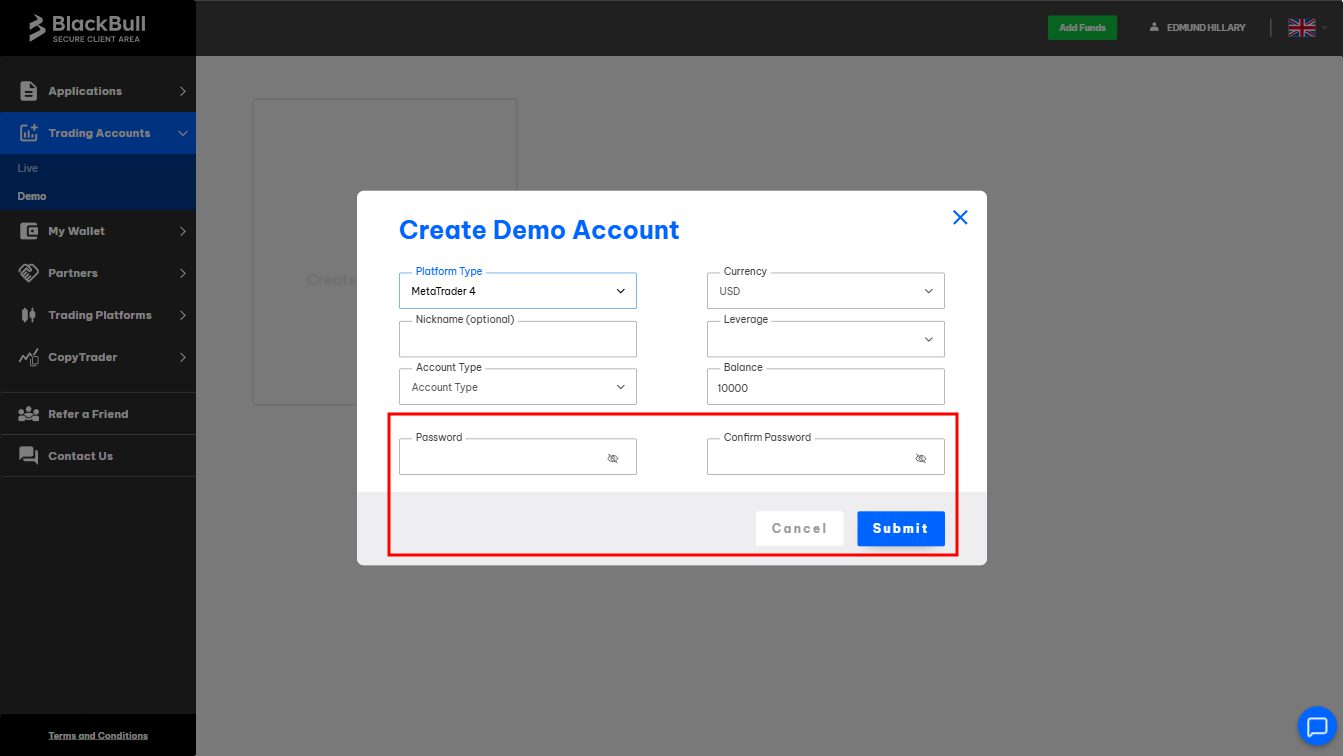
By starting with a paper trading account, you can run a strategy through a sample size of at least 100 simulated trades to determine if the trading plan has a positive outcome. Also, many traders we work with discover that simulation helps them spot habits and psychological challenges that need work, giving them the chance to address them before they start trading with live funds.
This phase is the ideal time for learning the essentials of becoming a full-time day trader, including order types and the Pattern Day Trader rule. We recommend treating paper trading with the same seriousness you would apply to a live account because the habits formed during this period carry over directly.
3. Start Next To Your Job
When we coach traders, the single greatest cause of failure is the financial pressure to generate immediate income from an account that is not yet large or consistent enough to support a household. When a mortgage payment depends on the next few hours of price movement, decision-making degrades sharply, leading to forced trades that do not meet the plan’s criteria.
We recommend maintaining full-time employment while you learn the basics and watch real examples of professional trade management. This approach removes the burden of monthly expenses from the trading account, allowing the balance to compound through skill rather than being drained by withdrawals. Retaining a primary income source until trading revenue consistently exceeds it for 6 to 12 months is one of the best options for becoming a full-time trader
Many successful traders we have observed focus on the first 90 minutes of the U.S. market open before commuting to work, while others build their schedule around the London and New York session overlap. At WR Trading, we specifically teach day trading strategies that can be executed with just 1 to 2 hours of focused trading per day.
Checklist Before Trading Full Time
- Keep your job
- Learn and paper trade
- Track personal finances and build a runway
- Quit only once profitable and funded
How Much Should You Save Before Quitting
We recommend saving 6 to 12 months of living expenses before leaving your job so you can focus on trading and not worry about making next month’s bills. This savings buffer should sit outside your trading account because withdrawing from a small trading account kills compounding and prevents your account from growing. For example, if your monthly expenses are $2,500, a 12-month runway would require $30,000 in savings.
4. Learn The Basics
Before you start trading in a paper account, you need a solid understanding of the basic tools, concepts, and order types used in the market. The first skill every trader must acquire is the ability to navigate a trading platform and execute orders without hesitation, because hesitation during a live trade leads to missed entries and sloppy exits that cost real money.
You need to know precisely how to place a market order for immediate execution, a limit order to control your entry price, and a stop order to trigger an exit when the price moves against you. Leverage requires equal attention, as it multiplies your buying power while simultaneously magnifying the dollar impact of every tick the market moves, meaning a 1% price move against a highly leveraged position can erase a substantial portion of your account.
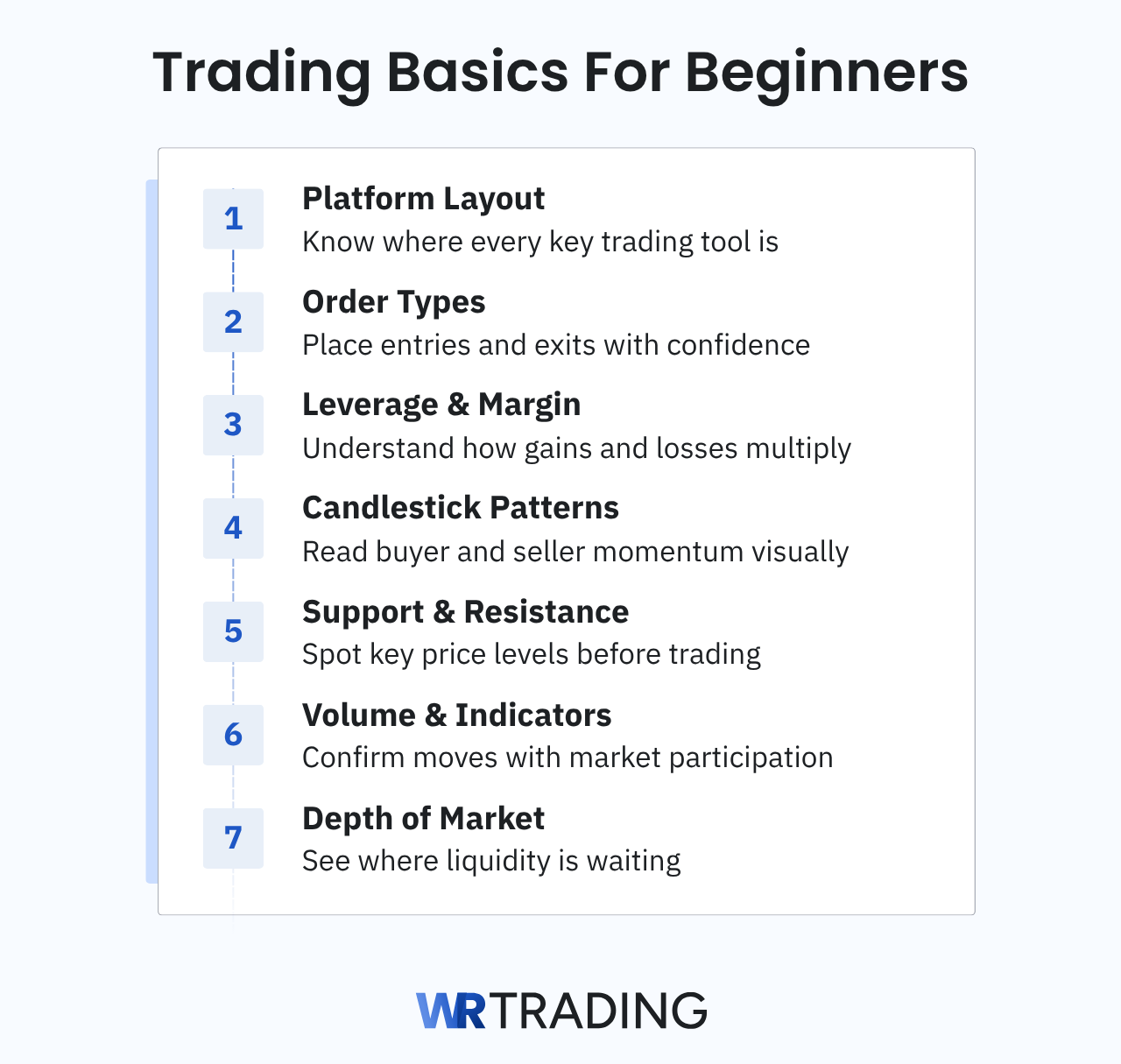
Moreover, take the time to learn how volume and candlestick patterns work to help reveal shifts in momentum between buyers and sellers at critical price levels. A few beginner-friendly patterns to start with are engulfing bars, pin bars, and inside bars.
Indicators like simple moving averages are supplementary tools that confirm whether price action has genuine participation behind it or is simply drifting on low interest. We advise learning the Depth of Market window, called the DOM, which shows stacked limit orders waiting to be filled and highlights exactly where other traders have placed their liquidity. The main trading aspects beginners should focus on are:
- Trading platform layout
- Order types
- Leverage and margin
- Candlestick patterns
- Support and resistance
- Volume and indicators
- Depth of Market
5. Watch Real Examples
In our experience, watching a professional trader navigate live markets teaches you more in a few hours than spending that time reading trading books ever will, because textbooks only show you the clean version of a setup, not the chaos of a live order book. We recommend finding trade recap videos where the trader shares their screen and explains exactly why they entered, where they placed their stop, and how they managed the position as it developed.
Pay attention to the moments when the price moves against them immediately after entry, because those are the situations that cause beginners to panic and make emotional decisions, while an expert trader simply follows the plan and either takes the small loss or lets the trade play out. This kind of observational learning helps you internalize what a valid setup actually looks like in real time, not just on a historical chart where everything seems obvious.
At WR Trading, we tell our students to spend at least a couple of hours each week reviewing this type of content, and to focus specifically on traders who show their losses with the same transparency as their wins. A professional who walks through a losing trade and explains what they missed or why the setup failed provides just as much value as a highlight reel of winners.
Take notes on how they handle trade management, including partial profits, trailing stops, and the decision to cut a trade early when conditions shift. Then compare those observations to your own paper trading journal to spot the gaps between what you are doing and what the professional model looks like, because that gap is where the real work of improvement happens.
6. Open A Brokerage Account
When you are ready to open a brokerage account, our professional recommendation is to prioritize safety and reliability over flashy features. Choose a broker regulated by a reputable authority in your region, such as the SEC, FINRA, the FCA, ASIC, or CySEC, because this oversight ensures that your funds are held in segregated accounts and that the broker adheres to strict operational standards.
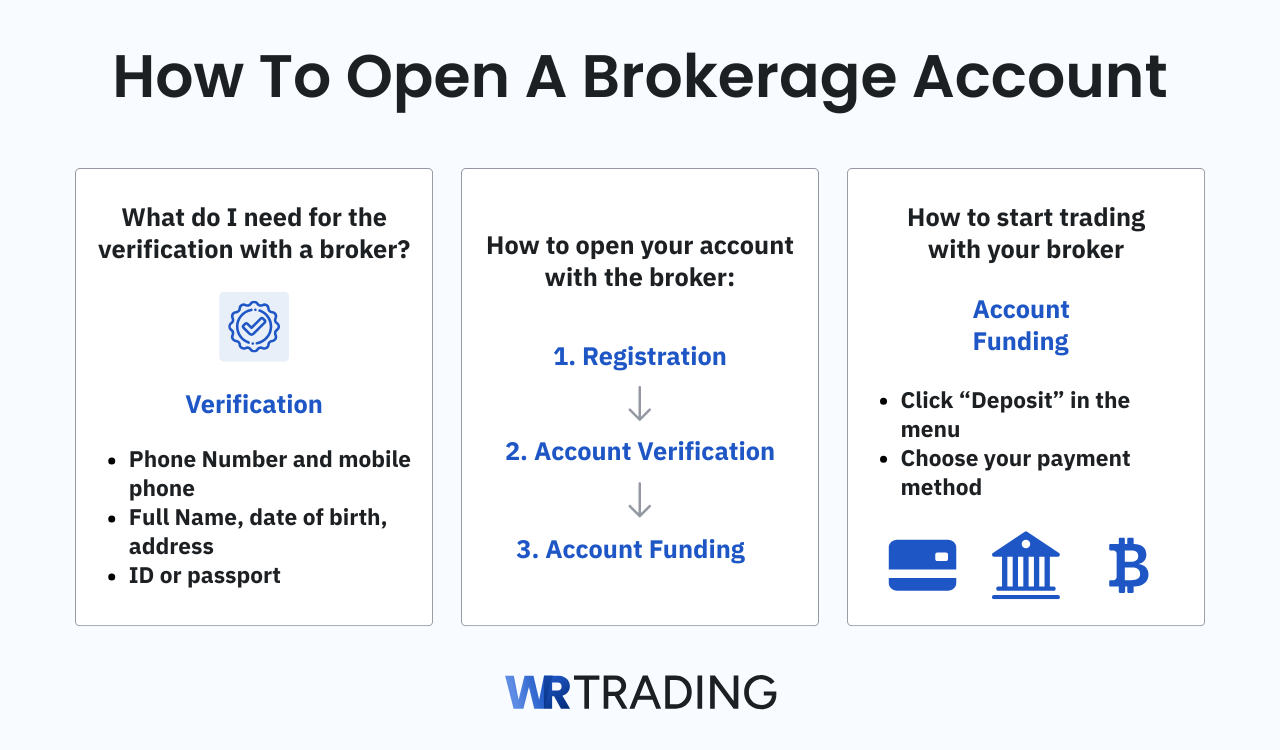
We also suggest looking into the broker’s execution quality and order routing practices, since a slightly wider spread or slower fill on each trade adds up quickly when you are active in the markets daily. At WR Trading, we advise our students to test a broker’s platform with a small deposit first to confirm that the software runs smoothly during high-volume periods, such as market open, before committing their full trading capital.
The tools and data feeds a broker provides are just as important as regulatory standing, so confirm that real-time quotes, Level 2 market depth, and Time and Sales are included, with no hidden fees. Ideally, you should select a broker that has a balance between usability and functionality for beginners, and one that provides responsive customer support when you inevitably have a question about an order or a platform issue.
7. Put In Months and Years Of Hard Work
New traders often struggle when they set unrealistic timelines, and we advise having a clear understanding of what actually motivates you to pursue this path of becoming a full-time day trader. For us, the biggest motivators were financial freedom, control over our schedules, the chance to work toward a higher income ceiling, and the independence that comes with relying on our skills rather than a traditional paycheck.
The data we have reviewed shows that profitable traders spend one to three years developing consistency, and anyone pursuing this career must be willing to put in months and years of hard work before expecting to replace a full-time income. We recommend writing down your specific motivation and keeping it somewhere visible, because you will need to revisit it during drawdowns and losing streaks when the daily P&L is not providing any encouragement.
The first year is mainly about eliminating basic execution errors, learning to manage risk on every single trade, and understanding one specific strategy well enough to apply it under live conditions without freezing up. The second year tends to focus on adapting that strategy to different periods of volatility and strengthening the mental discipline required to follow a plan even when it is boring or uncomfortable.
By year three, many of the traders we have mentored begin to see the kind of steady performance that justifies gradually increasing position size. Throughout this period, we recommend focusing on process over profit, as watching the daily P&L leads to emotional decisions, while concentrating on proper execution builds the habits that eventually produce reliable returns.
8. Test Out Different Strategies
In our experience, the traders who survive long enough to become consistently profitable are those who have experimented with multiple strategies and learned the specific market conditions where each method thrives. For example, a momentum breakout strategy that performs brilliantly during a strong uptrend will often bleed small losses and false signals the moment the market shifts into a choppy, directionless range.
Therefore, we advise testing several different styles in a paper trading account before committing real capital to any single one, because you need firsthand experience with how each approach feels to execute under pressure. Common strategies worth exploring include momentum trading, which targets stocks with unusual volume and rapid price movement driven by fresh news, and scalping, which aims to capture very small profits on a high frequency of trades held for seconds or minutes.
Ideally, run each strategy through at least 50 simulated trades to find the best match for your trading style and risk tolerance, because a trader who cannot stomach frequent small losses will be miserable trying to scalp, and an impatient trader will struggle with the waiting required for range trading setups. The goal is to identify an approach you can execute with discipline day after day, not the one that looks like it would offer fast profits.
9. Create A Trading Plan
A written trading plan is your personal rulebook that keeps you grounded in execution when the market is moving fast, and your emotions are urging you to chase a move or hold a loser too long. The primary purpose of this document is to shift your attention away from the daily P&L and toward the specific actions you control, because focus on process over profit is what separates traders who last from those who burn out after a few volatile weeks.
The plan should specify exactly which market and instrument you trade, define entry criteria with no room for interpretation, and include a precise formula for position sizing based on the distance to your stop-loss. When your only job during trading is to follow the checklist, you free yourself from the mental weight of wondering whether each trade will be a winner, and that alone improves decision-making more than any indicator ever could. Also, use a risk-reward calculator to accurately see if the trade is worth the stake before committing
Furthermore, the plan needs a defined stop placement that immediately signals when the trade idea is invalid, profit targets for both partial and full exits, and a daily loss limit that forces you to walk away once you hit a predetermined threshold. We recommend printing this document and keeping it beside your screen, then reading it before each session to lock in the mindset that you are there to execute a repeatable process, not to hit a specific dollar target.
10. Analyze Results
Trading generates an enormous amount of data, and we noticed that traders who consistently improve are those who treat that information as a tool for gaining insights. At the end of each week, we recommend exporting your trade history and calculating the core metrics that reveal the actual quality of your execution: win rate, the ratio of average win size to average loss size, profit factor, and expectancy per trade.
A high win rate paired with a poor average win-to-loss ratio signals that you are taking profits too early relative to the risk you assume on each entry, while a lower win rate with larger average wins reflects a trend-following approach that is working as long as your profit factor stays above 1.5.
This weekly review allows you to pinpoint which specific setups and which times of day produce your strongest results, and just as importantly, which recurring behaviors are quietly draining your account. We have watched traders completely turn their performance around by committing to a disciplined weekly journal review and making incremental adjustments based on the data.
The objective is not perfection on every trade, because that is impossible, but to steadily eliminate the mistakes that are within your control while leaning harder into the patterns that are already profitable. This kind of focused, data-driven refinement is what enables a professional trader to consistently deliver results week by week.
| Metric | Definition |
|---|---|
| Win Rate | The percentage of trades that close in profit. |
| Win / Loss Ratio | The average size of your winning trades divided by the average size of your losing trades. |
| Profit Factor | Total gross profits divided by the total gross losses. A value above 1.0 indicates profitability. |
| Expectancy | The average dollar amount you expect to make per trade calculated as (win rate x average win) – (loss rate x average loss). |
Risks You Have To Take When Becoming A Full-Time Day Trader
Becoming a full-time trader has several negative aspects that are rarely discussed, as most focus only on the positives, but they are essential to know before you commit real money or leave a stable job. The main risk we see is the psychological toll of watching a position move against you while your hard-earned capital is on the line, which is something no amount of paper trading can fully replicate. Plus, it hits differently when the account balance represents months of savings or future rent payments.
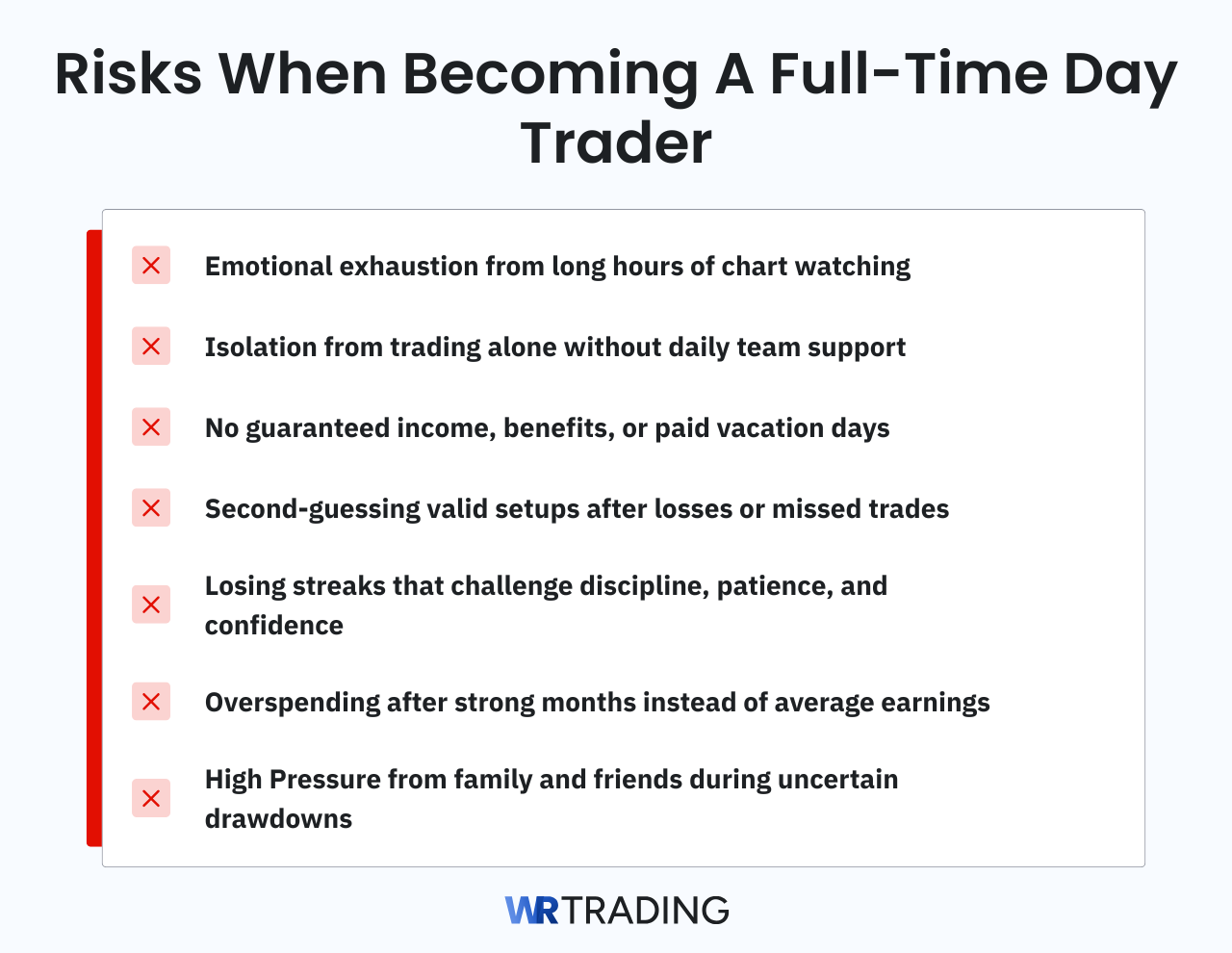
Furthermore, there will be stretches where you follow your plan perfectly and still lose money for days or even weeks in a row, and those losing streaks can trigger self-doubt, frustration, and the urge to abandon a sound strategy at the worst possible moment. Also, the isolation of working alone behind a screen, without coworkers to bounce ideas off or a manager providing structure, is another challenge that many new traders underestimate until they are several months into the journey.
- Emotional exhaustion: Staring at charts for hours while managing real financial exposure drains mental energy far faster than a standard desk job. Many traders report feeling completely depleted by the afternoon, which can affect personal relationships and overall quality of life outside of market hours.
- Isolation and lack of social interaction: Trading from home means spending long hours alone with your thoughts and screens, without the casual office banter or team support that are a buffer against stress. This solitude can amplify anxiety during losing days and make it harder to maintain perspective on your overall progress.
- No guaranteed income or benefits: Unlike traditional employment, there is no guaranteed paycheck arriving every two weeks and no employer subsidizing health insurance, retirement contributions, or paid time off. You must budget for these expenses yourself and accept that some months will yield negative returns regardless of your skill level.
- Second-guessing and analysis paralysis: After a series of losses, you may find yourself hesitating on valid setups that you would have taken without issue during a winning streak. This hesitation causes you to miss profitable opportunities, which then feeds further frustration and a cycle of self-doubt.
- Extended losing streaks: You will encounter periods where nothing seems to work and every trade stops out, even when you follow your plan perfectly. These streaks test your discipline more than winning ever will and are the moments when most traders abandon their edge or start taking excessive risks to make back losses quickly.
- Lifestyle changes and financial mismanagement: A few good months can create the illusion that high income is now permanent, leading to increased personal spending that becomes unsustainable during the inevitable drawdown period. We have watched traders dig themselves into financial holes because they adjusted their lifestyle to peak earnings rather than average earnings.
- Family and social pressure: Friends and family who do not understand trading may view your profession as gambling or question why you left a stable career for something so uncertain. This external pressure can weigh heavily, especially during periods when your account is underperforming, and you are already questioning your own decisions.
How Much Time Per Day Do You Need To Do Day Trading?
The time you spend actively trading depends on the approach you settle on, as different strategies require varying levels of screen time. A scalper looking to grab a few cents on high-volume moves might be finished within the first 90 minutes after the market opens, leaving the rest of the day to use other strategies. A momentum trader who waits for specific setups to develop could monitor the screens for three or four hours and place only a handful of actual trades.
A range trader who identifies a clear channel early in the morning might hold a single position for two or three hours while checking in periodically. Depending on the strategy you choose, the time horizons for any given position can span from thirty seconds for a scalper to several hours for someone trading off support and resistance levels on a higher timeframe chart. However, in general, you’ll log up to 40 hours a week as a full-time trader for pre-market preparation, trading, post-market review, and ongoing education.
At WR Trading, we teach methods that require roughly one to two hours of focused execution per day on 1-minute charts because we have found that this window captures the most productive market movement. You still need to account for 15 to 30 minutes of pre-market preparation to scan for setups, and another 15 minutes after you finish to journal your trades and log your metrics. The reality is that full-time trading is less about filling an eight-hour shift and more about being fully present and disciplined during the specific window where your edge exists.
How Much Money Do You Need To Do It Full Time?
Let’s be direct about the numbers because this is where a lot of aspiring traders get stuck or misled. We recommend aiming for an account size of approximately $100,000 to $200,000 if you plan to follow the 1% risk-per-trade model and eventually replace a full-time income. Here is the simple math behind that figure. With $100,000 and a strict rule of risking no more than 1% per trade, you are putting $1,000 on the line with each position, and even a solid trader pulling in 15% to 20% annual returns would generate $15,000 to $20,000 before taxes.
That is supplemental income, not a living wage in most places. Pushing closer to $200,000 gives you more breathing room, both in terms of the dollar amount you can risk per trade and the annual income you can realistically expect to draw without the constant pressure of needing every trade to work out. Also, if you withdraw money, you do not have the scaling effects of compound interest.

Now there is another route that has become popular in recent years, and that’s trading through a proprietary trading firm where you pass an evaluation and gain access to the firm’s capital instead of risking your own savings. These prop firm programs can be cheaper upfront, costing a few hundred dollars per evaluation attempt rather than requiring you to self-fund a six-figure account.
How Much Experience Do You Need?
We tell every trader to expect a timeline of 1 to 3 years before they should seriously consider transitioning to full-time status, and that range is pulled from watching hundreds of traders navigate this exact path. The time is not just about logging hours in front of a screen but about accumulating three specific types of experience that cannot be rushed.
- First, you need to experience the markets, meaning you have traded through enough different conditions, uptrends, downtrends, choppy sideways slogs, and high-volatility news events, to know how your strategy holds up when things get difficult.
- Second, you need the kind of experience trading yourself that comes only from making real mistakes with real money and learning your own tendencies, such as being prone to revenge trading or moving stops too early.
- Third, you need genuine marketplace experience, which is the intuitive feel for order flow and price action that develops after seeing thousands of setups play out in real time rather than on a static chart after the fact. That combination of skills cannot be compressed in less than a year, no matter how many hours a day you study or how many YouTube videos you watch. The market does not care about your timeline or your financial goals, and it will teach you lessons on its own schedule, whether you are ready for them or not.
Is Day Trading Full-Time Suitable for Everyone?
No, full-time day trading is not a suitable career path for most people, and the high failure rate of over 80% in this industry exists for good reason. The combination of unpredictable income, intense psychological pressure, and the discipline required to follow a plan day after day without anyone holding you accountable eliminates a large percentage of those who attempt it.
Different trader types face different challenges, a scalper might burn out from the sheer mental exhaustion of making dozens of rapid decisions each session, while a momentum trader might struggle with the patience required to wait hours for the right setup to appear. Also, there is the risk of isolation, the risk of watching your savings fluctuate daily, and the risk of investing years of your life into a pursuit that may not pay off financially.
We have seen talented, intelligent individuals wash out of this industry not because they lacked skill but because the lifestyle and psychological demands simply did not align with their personality or financial needs. That said, there are specific traits that tend to correlate with long-term success in this field, and if you recognize yourself in these descriptions, you may be better suited than the average person.
Successful full-time traders are comfortable operating within uncertainty and can accept a loss on any given trade without letting it affect their confidence or their next decision. They have enough self-discipline to follow a plan even when every instinct is screaming at them to do something different, and they have financial resources that allow them to withstand drawdowns without panic. They are also self-motivated enough to maintain a routine and stay productive without external accountability from a manager or team structure.
Pros & Cons Of Becoming A Day-Trader
Pros
- You keep all the profits you make instead of earning a fixed wage
- You choose when to start and stop working each day
- You can trade from home or anywhere with good internet
- No boss looking over your shoulder or telling you what to do
- Profits are available right away instead of waiting for a paycheck
- You learn skills that apply to managing your own investments long-term
- You can start small and grow your account at your own pace
- The work is different every day, so it rarely feels repetitive
- There is no limit to how much you can improve and earn over time
- You do not need a degree or special certification to begin
Cons
- Some months you will lose money instead of making any
- No paid sick days, vacation time, or health insurance included
- Watching your account drop during a losing streak is stressful
- You sit alone at a screen for hours with little social contact
- It can take years before you earn a reliable income
- There is pressure to trade even when you do not feel your best
- It is easy to overtrade when you are trying to recover a loss
- Rules and tax laws around trading can change without warning
- Bad habits like revenge trading can undo weeks of good work in hours
- Finding a regular job later can be harder with a gap on your resume
Become A Full-Time Day Trader with WR Trading
We teach a straightforward approach to day trading that fits into a 1 to 2 hour daily window, which means you can learn and practice without quitting your job. Our focus is on finding trades with high risk-reward ratios, often five or ten times the amount you put at risk, so you do not need to win every trade to finish the month ahead.
Our process is built around a clear set of rules: knowing exactly when to enter, when to exit, and just as importantly, when to wait for better conditions. The professional mentorship follows three stages that take you from observing live price action to consistently trading a demo account, and finally to live execution with direct feedback and weekly webinars led by profitable traders.
With us, you get personal coaching because trading alone makes it hard to spot the mistakes that are hurting your performance. There is no hype or empty promises at WR Trading, just a structured plan designed to shorten your learning curve and help you avoid the common errors that cost beginners time and money. If you are ready to become a day trader and earn a living with a routine that respects your time, visit WR Trading and see how our mentorship can get you there faster.
FAQs
Can I Start Day Trading With a Small Account Like $500 or $1,000?
Yes, you can start with a small account, but you need to keep your expectations realistic about the dollar returns at that size. With $1,000 and a strict 1% risk per trade, you are risking only $10 per trade, which means even a great month of 5% returns puts just $50 in your pocket. We recommend starting small to learn the mechanics without pressure, then adding more capital once you have a few months of consistent execution documented.
How Do I Know When I Am Ready to Switch From Paper Trading to Real Money?
You are ready to switch when you can show three consecutive months of profitable paper trading results with a profit factor above 1.5, and you have followed your plan without skipping trades or bending your rules. We recommend setting aside a small amount of money you are fully prepared to lose, which removes the fear that every individual trade must be a winner.
Do I Need a Demo Account or Can I Just Jump Into Live Trading?
Yes, you absolutely need a demo account first, and we say this because we have watched too many beginners blow real money on mistakes they could have made for free. A demo account lets you learn the platform layout, understand how orders fill in fast markets, and test whether you can follow a plan without the pressure of losing actual cash.
What Are the Best Tips for Someone Who Wants to Become a Full‑Time Day Trader?
Start with a paper trading account and practice until you show at least three consecutive profitable months. Keep your current job while you learn, because the financial pressure of needing trading income leads to bad decisions like revenge trading. Focus on risking only 1% of your account per trade, which allows you to survive losing streaks and trade long enough to improve.
What Are the Best Brokers for Full-Time Day Traders?
The best brokers for full-time day traders are StarTrader, Vantage, and Blackbull Markets. All three are regulated by reputable authorities, offer a variety of professional trading platforms, a wide range of asset types, and reliable trade execution. Each broker offers MetaTrader 4, MetaTrader 5, and proprietary mobile apps, plus demo accounts that let you practice strategies before trading live.

